
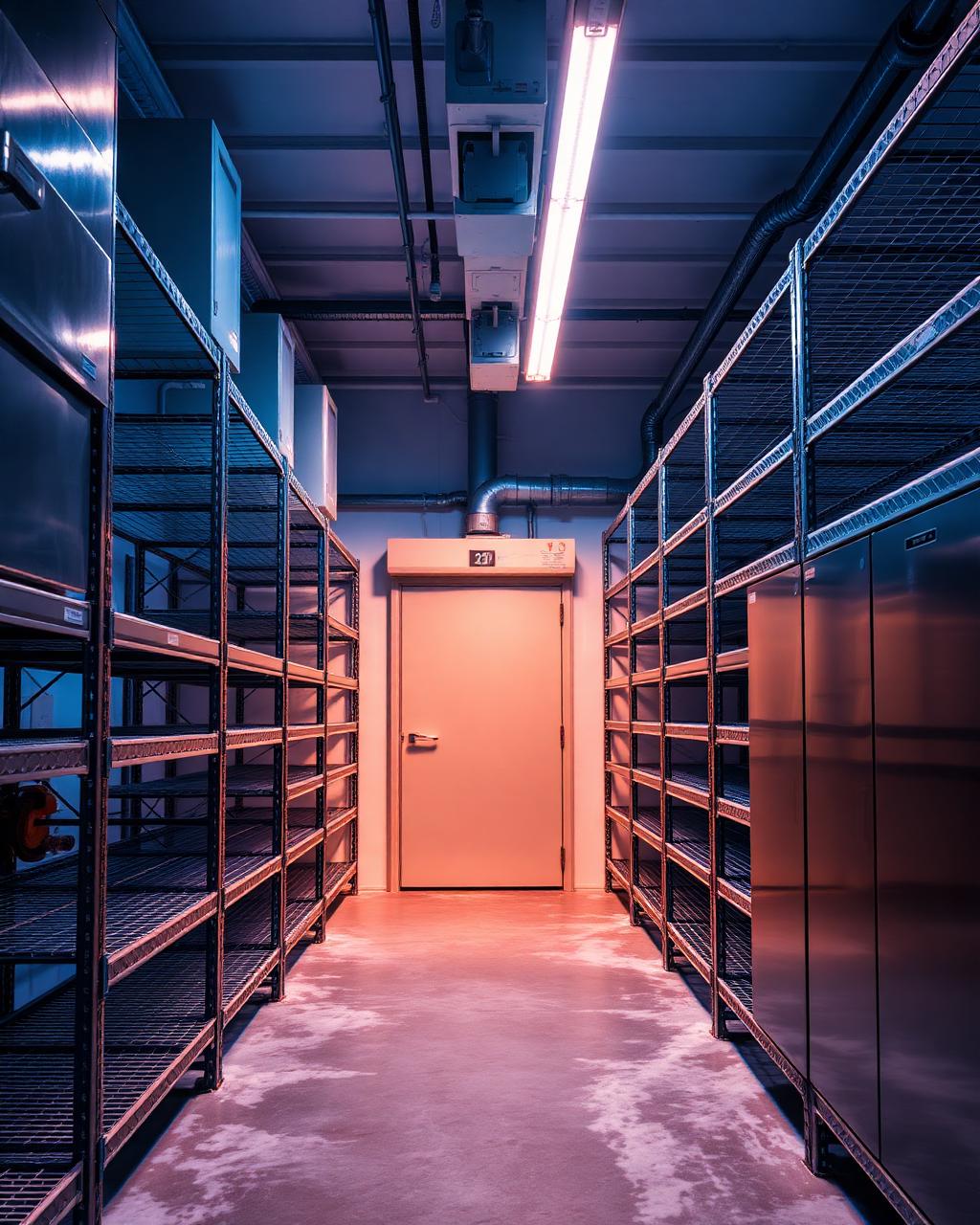
A cold room failure is rarely just a repair bill. For a restaurant, butcher, farm shop or catering business, it is a stock write-off, a service disruption and a food safety record that has to be explained. The good news is that the failures are predictable: undersizing, poor airflow, neglected condensers, blocked drains and doors left open account for the overwhelming majority of call-outs. All five are avoidable at design and maintenance stage.
Key takeaways
- Chilled storage is typically held at 0–5°C; frozen at −18°C or below.
- Size on heat load and product turnover, not just cubic metres.
- Continuous temperature monitoring with alarms is the single best investment in a cold room.
- Condenser cleaning is the maintenance task with the biggest return.
- Door discipline and strip curtains materially cut running costs and defrost cycles.
Temperature targets and why they matter
UK food hygiene requirements mean chilled food must generally be kept at 8°C or below, and industry practice is to run chilled rooms at 0–5°C to give headroom against door openings and warm deliveries. Frozen storage runs at −18°C or below. Your HACCP plan should state your own target and tolerance, and your monitoring should demonstrate you hold it.
The headroom point is the practical one. A room set at 7°C has almost no margin: one busy delivery morning with the door propped and you are outside your limits with product that has to be assessed or binned. A room set at 3°C absorbs that without drama.
Sizing: what a proper calculation includes
Cold room sizing is a heat load calculation, and volume is only the starting point. Ask any supplier what figures they used for the following.
- Transmission load through walls, floor and ceiling — a function of panel thickness and the temperature of the surrounding space.
- Product pull-down load — how much product arrives, at what temperature, and how quickly it must reach target. A room receiving warm cooked product needs far more capacity than one receiving pre-chilled stock.
- Infiltration load — door openings per hour, and whether strip curtains or an air curtain are fitted.
- Internal loads — lighting, evaporator fan motors, and staff working inside.
- Defrost load — particularly significant in freezer rooms.
- Ambient conditions where the condenser sits. A condenser in an unventilated back-of-house corner in August is not seeing design conditions.
| Application | Typical target | Design note |
|---|---|---|
| Chilled produce and dairy | 1 – 4°C | Watch humidity to prevent product drying |
| Fresh meat and fish | 0 – 2°C | Tight tolerance; monitoring is critical |
| Beverage and bar store | 3 – 6°C | High door frequency during service |
| Frozen storage | −18°C or below | Defrost strategy and floor insulation matter |
| Blast chilling | Product-specific | Sized on product mass and time, not room volume |
Airflow: the detail that gets ignored
A correctly sized system in a badly packed room still fails. Evaporators need a clear air path, and product needs air moving around it. Stock stacked hard against an evaporator or piled to the ceiling creates warm pockets that no amount of capacity fixes.
- 1Keep a clear zone in front of the evaporator — at least the distance the manufacturer specifies, typically several hundred millimetres.
- 2Never stack product directly against walls; leave a gap for air circulation.
- 3Use slatted or wire shelving rather than solid, so air can move vertically.
- 4Keep the floor clear enough to allow return airflow to the evaporator.
- 5Do not store cardboard outers where they block airflow — decant where practical.
Monitoring and compliance evidence
Twice-daily manual temperature logs on a clipboard are still common, and they satisfy the basic requirement, but they tell you nothing about the eleven hours between readings. Continuous electronic monitoring with data logging and out-of-range alarms does three things at once: it protects stock, it produces the evidence an inspector or auditor wants, and it removes a daily task from your team.
What good monitoring looks like
- Calibrated probe measuring product or air temperature at a representative point
- Continuous logging with data retained for at least the period your HACCP plan requires
- High and low alarms with escalation to a phone, not just a beeper on the wall
- Alarm on door-open beyond a set duration
- Annual probe calibration, recorded
- Exportable reports for EHO visits and retailer audits
The alarm escalation point is the one that pays for itself. A failure at 2am on a Saturday discovered at 8am on Monday is a full stock loss; the same failure with a text alert at 2am is a call-out.
The five failures we see most
1. Dirty condensers
A condenser coil furred with dust, grease or kitchen extract residue cannot reject heat. The system runs longer, head pressure rises, efficiency drops and eventually the compressor fails. Quarterly cleaning in a kitchen environment is not excessive.
2. Blocked condensate drains
Ice build-up on the evaporator, water on the floor and slip hazards usually trace back to a drain that has blocked or a trace heater that has failed on a freezer drain. Cheap to check, expensive to ignore.
3. Door seals and closers
Perished gaskets, dropped hinges and broken closers let warm humid air in continuously. You can often see the result as frost patterns near the door. Seals are a consumable — budget for them.
4. Refrigerant leaks
Gradual loss of charge shows as longer run times and a room that no longer quite reaches target on hot days. It also carries F-Gas record and repair obligations. Repeated top-ups are a symptom, not a fix.
5. Undersized or overloaded rooms
Businesses grow into their cold rooms. A room specified for a 40-cover restaurant that is now doing 90 covers plus events will run permanently at capacity, hold temperature poorly and fail early. If your room never quite recovers after a delivery, capacity is the question to ask.
Maintenance schedule worth committing to
| Task | Frequency |
|---|---|
| Visual check, temperature log review, door seal inspection | Weekly (in-house) |
| Condenser coil clean | Quarterly in kitchens, twice yearly elsewhere |
| Evaporator clean and defrost check | Twice yearly |
| Drain flush and trace heater test | Twice yearly |
| Full service, electrical checks, performance readings | Twice yearly |
| Leak check per F-Gas interval | As required by CO₂ equivalent charge |
| Probe calibration | Annually |
Planning for failure
Every food business should have a written answer to one question: what happens if the cold room fails tonight? That usually means knowing which local supplier can provide temporary refrigeration at short notice, having a stock relocation plan, and holding an emergency contact number that reaches an engineer out of hours rather than a voicemail box.
Businesses across Ripley, Derby, Chesterfield and the surrounding villages often run on a single cold room with no redundancy, which makes response time the whole game. Agree it in advance, in writing, as part of your maintenance contract.
Frequently asked questions
What temperature should a commercial fridge be?+
Chilled storage should be at 8°C or below by law, with most operators targeting 0–5°C to leave headroom. Confirm the target in your own HACCP plan and monitor against it.
How long does a cold room hold temperature after a power cut?+
It depends on insulation, load and door discipline, but a well-insulated full room kept closed can hold safe temperatures for several hours. Opening the door repeatedly destroys that margin.
Do cold rooms need F-Gas leak checks?+
If the system's CO₂ equivalent charge is at or above 5 tonnes, yes, at the interval set by that figure. Your contractor should confirm the calculation for each system.
Is it cheaper to repair or replace an old cold room?+
If the panels are sound, replacing the refrigeration pack on a modern low-GWP refrigerant is often the better value option. Failing panels or persistent floor issues usually tip it towards replacement.