
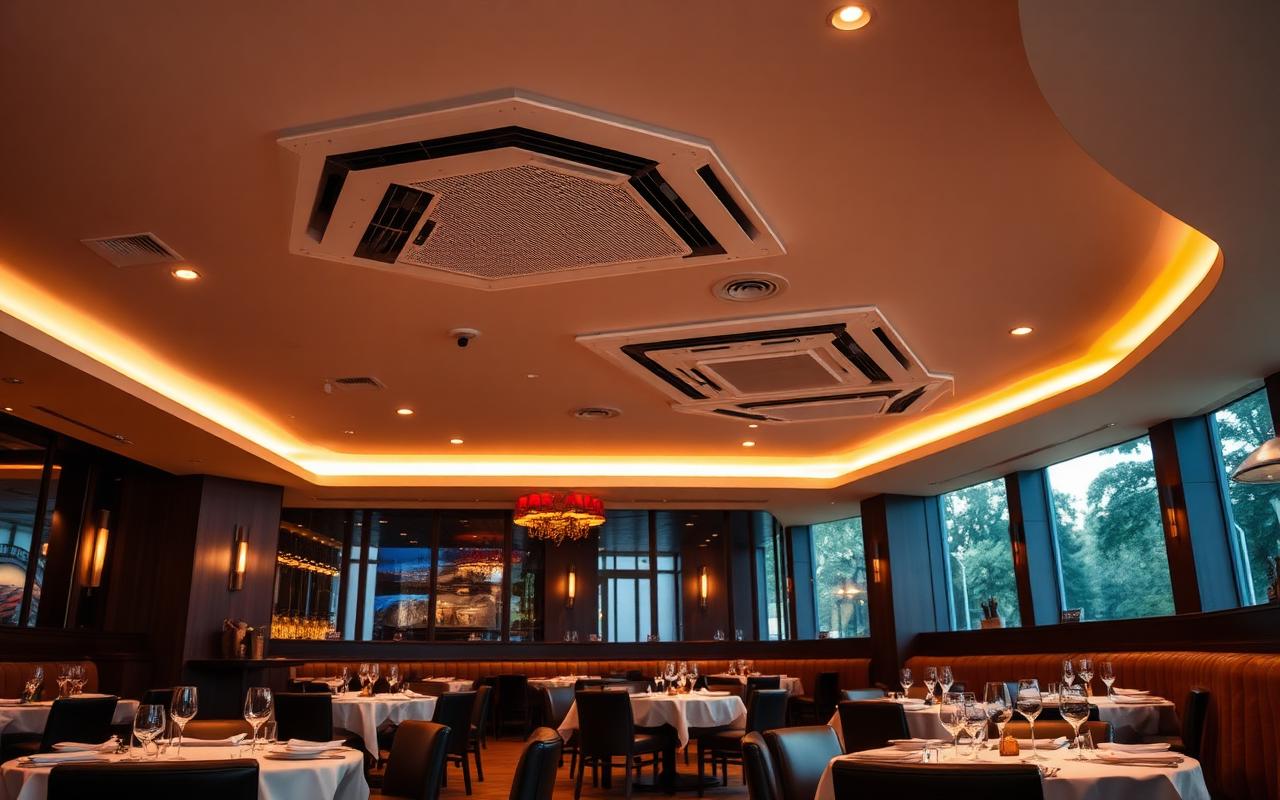
Hospitality is the hardest environment for cooling equipment in this industry. Kitchens run enormous heat loads and coat everything in grease-laden air; dining rooms need to be quiet, draught-free and comfortable within minutes of a full sitting arriving. Treating both with the same equipment specification is the most common and most expensive mistake we see in pubs and restaurants across Derbyshire.
Key takeaways
- Kitchens are primarily a ventilation problem; dining rooms are primarily a cooling problem.
- Extraction without make-up air creates negative pressure, draughts and poor canopy performance.
- Grease shortens equipment life dramatically without a filtration and cleaning regime.
- Dining room comfort depends on air distribution and noise as much as capacity.
- Plan capacity around a full house on the hottest evening, not an average Tuesday.
The kitchen: ventilation first, cooling second
A commercial kitchen line can generate 15–40kW of heat from cooking equipment alone. No sensible amount of air conditioning removes that; the canopy and extract system does. Cooling in a kitchen is a supplementary measure to make the space workable once extraction is doing its job properly, and it is wasted money if the ventilation is wrong.
The first thing to check in a hot kitchen is not the air conditioning — it is whether the extract rate matches the equipment beneath the canopy, whether the filters are clean, and whether there is a designed source of replacement air.
Make-up air is the missing piece
If you extract 4,000 litres per second and provide no designed make-up air, that air comes in anyway — through door gaps, from the dining room, and down flues. The symptoms are recognisable in a lot of older pub kitchens: doors that slam or stick, cold draughts across the pass in winter, cooking smells drifting into front of house, and a canopy that visibly fails to capture steam.
- Make-up air should be roughly 80–90% of the extract volume, delivered in a controlled way.
- It should be tempered in winter, or you create a cold zone that staff will block off.
- It should be introduced away from the canopy capture zone so it does not disturb the plume.
- Interlocking extract, make-up air and gas supply is a safety requirement on gas kitchens — a gas interlock system prevents cooking with the ventilation off.
Cooling the line
Where cooling is added, position matters more than capacity. Air blown directly at a canopy disturbs the capture plume and pushes cooking effluent into the room. The usual approach is cooling directed at the working aisle behind the line, or spot cooling at the pass and prep areas, with units selected for a hostile environment and easy filter access.
Grease and equipment life
Grease-laden air is what kills kitchen air conditioning. It coats coils, fouls fans, cakes filters and reduces heat transfer until the unit runs constantly and eventually fails. An identical unit that would last fifteen years in an office may last five in an unprotected kitchen.
Protecting equipment in a kitchen environment
- Specify washable, easily accessible filters and change the routine to monthly
- Schedule coil cleans quarterly, not annually
- Keep condensers away from kitchen extract discharge — recirculating greasy hot air ruins them
- Ensure canopy filters are cleaned to schedule; they are your first line of defence
- Keep ductwork cleaning records — insurers and fire risk assessors ask for them
- Budget for equipment replacement on a shorter cycle than front of house
Condenser placement is worth labouring. We have surveyed sites where the AC condenser sat two metres from the kitchen extract discharge, ingesting hot greasy air all day. The equipment was blamed; the layout was the problem.
Front of house: comfort is about distribution
Guests notice three things: temperature, draught and noise. A dining room can be at a perfect 22°C and still generate complaints if cold air is falling on table four, or if the unit above the bar drones through a quiet Tuesday evening.
- 1Map the unit positions against the actual table plan before installation, not after.
- 2Avoid throwing air directly down onto seated diners — use cassettes with adjustable vanes and set them properly at commissioning.
- 3Specify low sound ratings and check the figures at the fan speed the unit will actually run at during service.
- 4Zone the bar separately from the dining room; they have different occupancy patterns and heat loads.
- 5Give the entrance area its own attention — door opening on a busy evening dumps heat straight into the room.
- 6Consider heating capability for shoulder seasons and outdoor-adjacent areas.
Sizing for the evening that matters
A full restaurant is a substantial heat load. Eighty covers at roughly 100W of sensible heat each is 8kW of people before you count lighting, the bar, coffee machines and the sun on the west-facing windows during a summer service. Size for the busy Saturday in July, because that is the service where a comfort failure costs you reviews.
| Space | Main load driver | Design priority |
|---|---|---|
| Kitchen line | Cooking equipment | Extraction and make-up air |
| Pass and prep | Radiant heat from the line | Spot cooling, staff comfort |
| Dining room | Occupancy and glazing | Even distribution, low noise |
| Bar | Occupancy, glass washers, chillers | Separate zone, higher capacity per m² |
| Function room | Highly variable occupancy | Fast pull-down, independent control |
| Cellar | Product stability | Dedicated cellar cooling, not comfort AC |
Cellars are a separate discipline
Beer cellars need stable temperatures typically around 11–13°C, held consistently, with humidity control and equipment designed for continuous duty. Comfort air conditioning is not a cellar cooler and will not hold the tolerance product quality requires. If your cellar temperature drifts on hot days, your beer quality drifts with it — and that shows up in wastage and in customer perception long before anyone checks a thermometer.
Maintenance rhythm for hospitality
The most useful thing a hospitality operator can do is align plant maintenance with the trading calendar rather than the accounting one.
- Full service in April, before the first hot spell and before the summer trading peak.
- Second service in September or October, after the busy season and before winter heating use.
- Monthly in-house filter checks written into the kitchen and FOH cleaning schedules.
- Canopy and duct deep clean at the frequency your fire risk assessment and insurer specify.
- Cellar cooling checked ahead of summer, separately from comfort cooling.
- Out-of-hours cover agreed in writing — a Friday night failure needs a named number, not a ticket queue.
Hospitality margins do not absorb a lost weekend of trade. Planned maintenance in a quiet week is always cheaper than an emergency call-out during service, and it is the difference between a five-minute adjustment and a closed dining room.
Frequently asked questions
Can air conditioning replace kitchen extraction?+
No. Extraction removes cooking effluent, steam and heat at source and is a safety and hygiene requirement. Cooling is a comfort measure that works only once extraction is correct.
Why does our kitchen door slam or stick?+
Usually negative pressure from extraction without adequate make-up air. It also degrades canopy capture and pulls cooking smells into the dining room.
How often should restaurant AC be serviced?+
Twice a year as a minimum, with quarterly attention to kitchen units and filters monthly. Grease environments are far harder on equipment than offices.
Will air conditioning make the dining room noisy?+
Not if the units are selected and commissioned for the sound level at their working fan speed. Noise complaints almost always trace back to undersized units running flat out.