
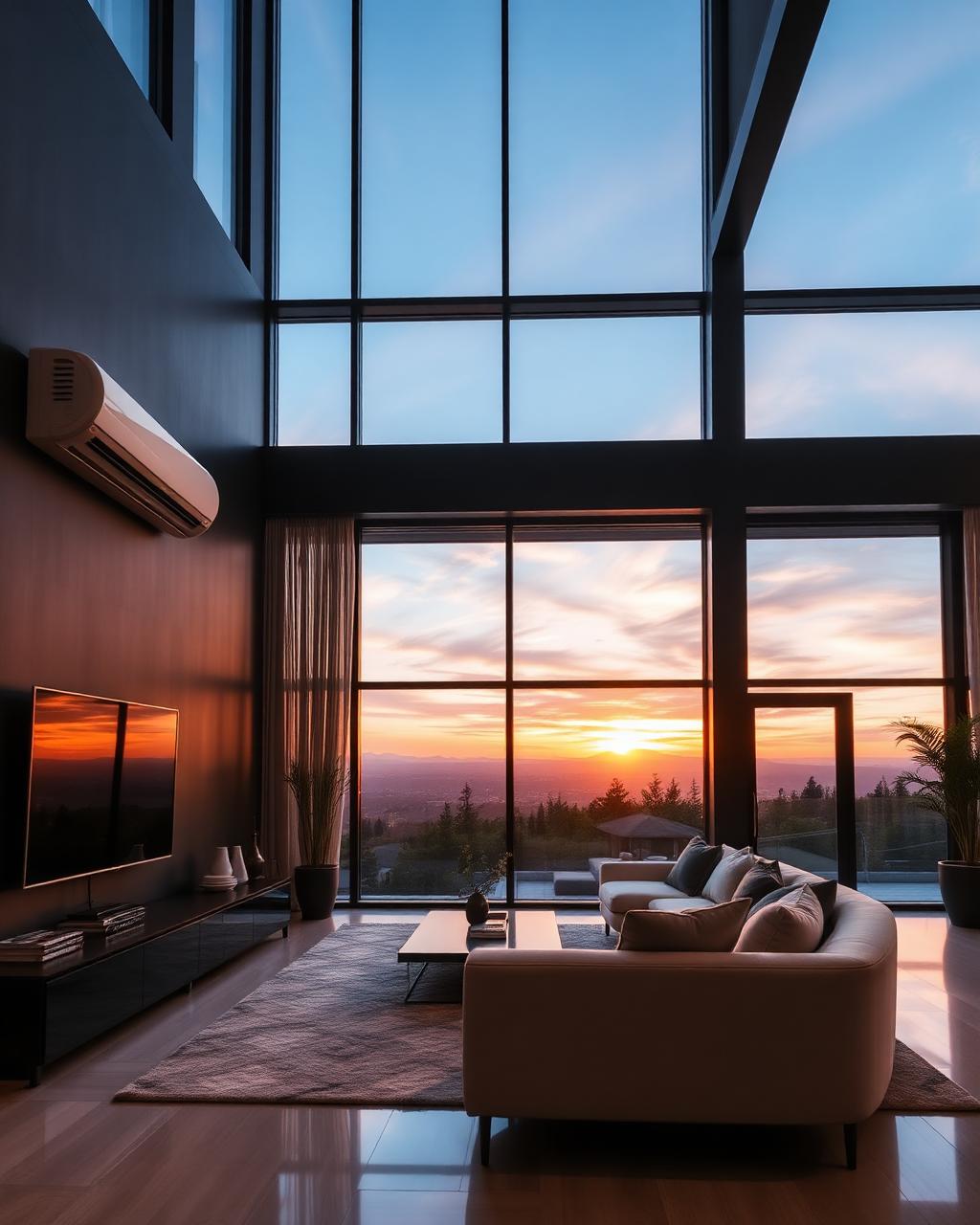
A south or west-facing conservatory can hit 40°C on a sunny Derbyshire afternoon even when the rest of the house is pleasant. Blinds and roof vents help, but they rarely solve the problem on their own. Air conditioning is the only solution that reliably brings the temperature down to a usable level. The challenge is that conservatories need far more cooling per square metre than ordinary rooms, and a standard living-room unit is almost always undersized. This guide explains how to size and choose a system that actually works.
Key takeaways
- Conservatories typically need 50–70% more cooling capacity than a normal room of the same size.
- Wall-mounted high-capacity splits and floor consoles are the most common solutions.
- Roof glazing, orientation and insulation quality dominate the heat load calculation.
- The same system can heat the conservatory efficiently in winter, extending usable months.
- Combine AC with roof blinds or solar reflective film for the best comfort and lowest running costs.
Why conservatories overheat so badly
Glass lets short-wave solar radiation in and then traps the long-wave heat that radiates back from the floor and furniture. That is the greenhouse effect in miniature. Even with a tiled roof and good vents, a conservatory can gain several kilowatts of heat on a bright day. A typical 20 m² conservatory with a glass roof can need 5–7kW of cooling on a hot afternoon.
Sizing rules for conservatory air conditioning
| Conservatory type | Cooling load guide | Typical unit capacity |
|---|---|---|
| Small 10–15 m² with solid roof | High but manageable | 3.5–4.5kW |
| Medium 15–20 m² with glass roof | Very high | 5.0–6.5kW |
| Large 20–30 m² with glass roof | Extreme | 6.5–9.0kW, possibly two units |
| South or west-facing | Add 20–30% | Size up accordingly |
Rough sizing guide. A full heat load survey is essential for glass rooms.
These figures are higher than the rules of thumb used for normal rooms because glass has almost no insulating value. A unit that looks oversized for the floor area is usually correct for a conservatory.
Best unit types for conservatories
- Wall-mounted high-capacity split. The most popular choice. Powerful, quiet and out of the way. Needs a suitable external wall.
- Floor console. Good when wall space is limited or the room has a low parapet. Blows air across the room at low level.
- Ceiling cassette. Effective in large conservatories with a flat or pitched internal ceiling. Distributes air in four directions.
- Portable units. Only useful as a temporary fix; they are noisy, inefficient and vent hot air back into the house unless ducted properly.
Outdoor unit placement
Conservatory air conditioning often needs a larger outdoor unit than people expect. It needs fresh airflow, level mounting, and enough clearance from walls and fences. Hiding it behind dense planting or in a tight corner will reduce efficiency and can trip the unit on hot days. A ground-level plinth or low wall bracket is usually better than a high mount.
Winter heating: the hidden benefit
A conservatory that is too hot in July is usually freezing in January. Because modern split systems are heat pumps, the same unit can heat the space efficiently in winter. That turns a conservatory from a three-season room into a year-round living space. For many homeowners, the heating benefit alone justifies the installation cost.
Get the most from conservatory AC
- Install solar reflective film or quality roof blinds to reduce the peak heat gain.
- Size the unit for the hottest expected day, not average summer weather.
- Use a programmable timer to pre-cool the room before the afternoon sun hits.
- Keep doors to the house closed when cooling so the system is not fighting the whole property.
- Service annually; coils clog faster in conservatories due to pollen and dust.
Frequently asked questions
Can a normal wall unit cool my conservatory?+
Only if it is sized correctly. A standard living-room unit is usually too small for the heat gain in a glass room.
Will air conditioning stop condensation in winter?+
It helps. By heating the glass and air, the system raises the dew point and reduces the chance of condensation forming.
Do I need planning permission?+
Usually not for a rear conservatory unit, but listed buildings and conservation areas may need approval. We cover this in our planning permission guide.
How much does it cost to run?+
A large conservatory unit working hard on a hot afternoon might cost £1.50–£3.00 per day. With blinds, reflective film and a timer, that can drop significantly.